
The Divine Appointment
How a Conversation Awakened the Courage to Be Fully Seen

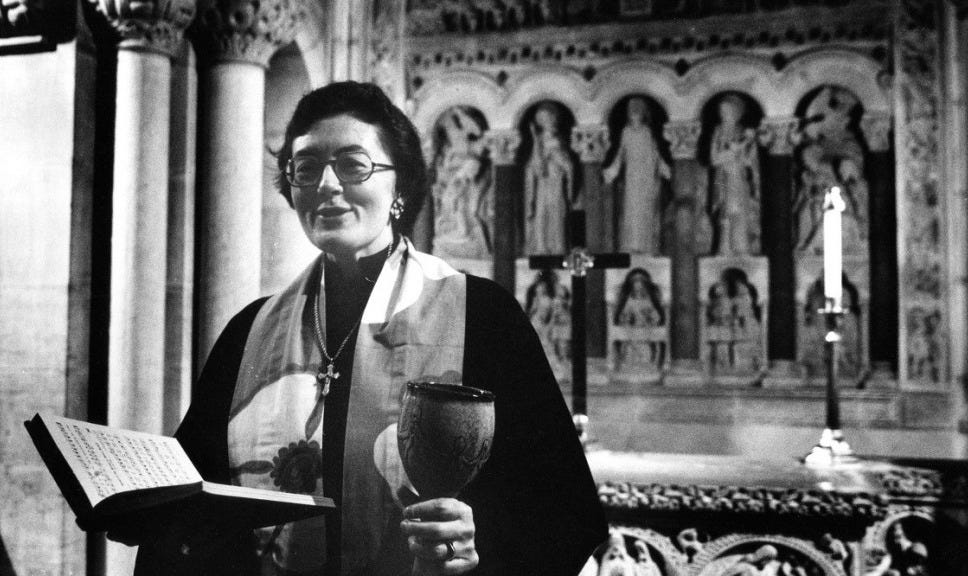
“I am one to tell you that a lesbian clergy woman can serve 37 years in this Minnesota conference and in the United Methodist Church faithfully…”
— Reverend Jeanne Audrey Powers
My friend, Kimberly Mendoza, sat across the table with cold half-eaten food, laptops, and coffee we used to guzzle down like water. When she asked me the question a thousand different responses shot through my head. Most of them were deflective jokes to change the subject. Very few of them held any hope because indoctrination had taught me that I had to be obedient with abstaining from natural sexual desires because Jesus wanted me to live a life of miserable celibacy.
“Do you think you will ever come out to the church?”
My chest ached with a longing I had been taught to bury, to crucify. In that moment, I knew what I wanted — to live openly, to love freely — but the catechism of silence hissed back: impossible. It was the lump in my throat all throughout high school well into my adult years. A truth trying to claw its way out of my throat, but I was taught to keep it swallowed.
“Probably never.”
We both understood why I would say that at the time. To me, the evangelical spaces where I had led worship were places where a queer voice would either be silenced or propagated because I’d be forced to publicly repent and live out a lie for the rest of my life. So, I compartmentalized every aspect of my existence — meticulous that the edges of the different facets of my life did not interact or even encounter one another for so many years.
A week after that conversation with Kim, our Worship Arts Leadership class in college was going to Pilgrim Place retirement community in Claremont, California. This was a living space for those who dedicated their lives to service and justice. We were assigned to have conversations with different individuals in ministry ranging from clergy members to missionaries.
Kimberly and I were paired up together. I would use the adverb ‘randomly’ here, but it would be a disservice to attribute the work of God’s hand on my life at this moment as a fleeting encounter of coincidence.
This was a divine appointment.
The caretaker took us to a woman sitting at a table so big that it seemed to swallow her tiny frail frame. She was in front of a big window giving us a glimpse of the San Gabriel Mountains that soared up into the clear and beautiful blue sky. When we came up to the lady, the mountains and the table, however, were tiny compared to the Spirit that dwelt inside of her.
The caretaker introduced us, in that moment, to Jeanne Audrey Powers.
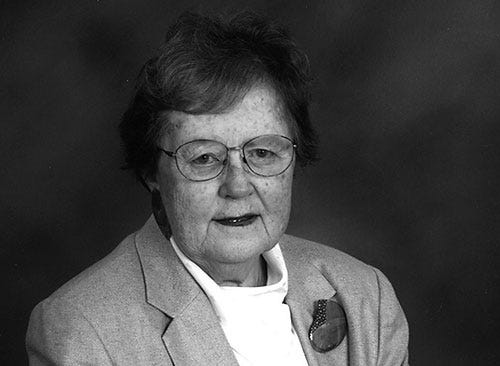
Powers grew up in Minnesota and pursued various degrees that would lead her into being ordained first as a deacon and then eventually an elder in the United Methodist Church in 1961. This would make her one of the first woman in the denomination to be granted full clergy status.
Jeanne Audrey Powers’ ministry was marked by fearless advocacy. She championed women in ministry across denominations and led courageous conversations about sexuality and gender identity long before it was safe to do so. In 1995, during a pivotal sermon at the Reconciling Ministries national gathering, she came out publicly as a lesbian. Her witness rippled through the church, unsettling some and liberating many.
Two decades later, this same woman of resilient faith sat before me and my friend, Kimberly, in early September of my junior year at Azusa Pacific University. The question Kim had asked me just a week earlier — the one that haunted the edges of my prayers — rose to the surface of my mind once again.
Looking back now, I have no doubt that this was more than coincidence. It was divine choreography: the Spirit arranging an encounter I didn’t know I needed. The very conversation that had unsettled my soul one week found its echo the next in the presence of a woman who had already lived the freedom I was afraid to imagine.
This was a divine appointment.
When we had sat down with Powers, she was curious about who we were and what we were there to learn about. After circling around the conversation for a little while with the same questions and responses, she revealed that she suffered from aphasia — a condition that disrupted her ability for fluid conversation. Yet soon, she began unrolling her life like a scroll.
I remember being in awe. Time felt like it had stopped as the Holy Spirit moved in that space. Fortunately, I had the foreknowledge to record our conversation in a voice memo that I hold close to my heart. The interaction had laughter, moments where we marveled, and a whole lot of gratitude for the work of God’s hand.
I left that day feeling poured into and inspired. The tunnel I was in had a light. Although it took me some time to navigate the maze of darkness, the warmth I had experienced that day guided me to fully realize God’s love for my entirety despite the world’s proclamation that there were parts of myself that I needed to remove to be whole in Christ. In reality, Christ’s love for me displayed on the cross makes me whole.
Later in the semester, our class was told that we were going to go back to the Pilgrim Place after writing a paper about the person we interviewed. Like every procrastinator, I waited to start the assignment until a couple of days before it was due and before we were going to go back to the retirement community. When I started gathering articles and resources for my report on Jeanne Audrey Powers, her obituary appeared.
A week after Kim and I had the privilege of sitting down and talking about Jeanne’s life, she had died. I was frozen. Stuck in between the holy and the echo chamber of God’s voice both remedying my broken inner child and calling me to something greater down the road of my ministry.
We went to that place where I got to share about my experience with Powers. Her community respected her greatly by their nods at the way her testimony impacted my life — revealing that Jeanne’s spirit had touched the lives of so many around her. It was more than a wonderful opportunity to be able to sit across from that remarkable woman and see how vivid clarity was given to her by God in that moment to tell her incredible story. It was divine.
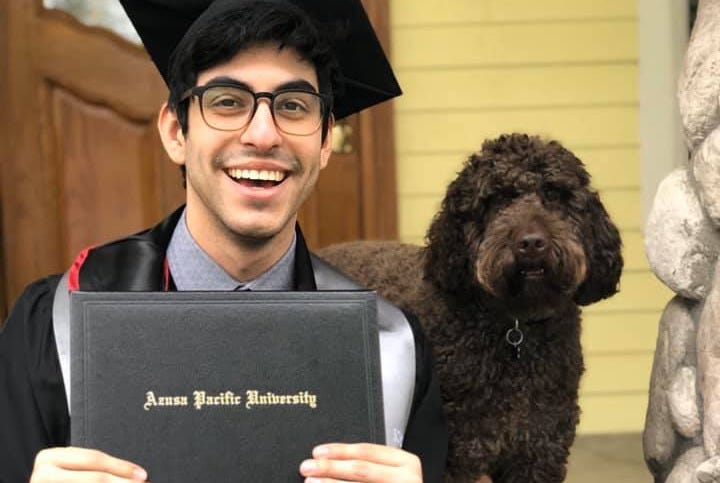
I have grown up to become the one beckoning the child I was back then to be forged and to be renewed in spirit. The dark thoughts, the weight loss, the depression, all of those things that came with the territory of being in the closet for the sake of others — it was all a fire, a moment to test and refine the depth and width of my love. Not just for myself but for people in general.
This life is so fleeting. I’m tired of spending it in shadows and keeping people at arms length. I have not been a great stewardship of Christ because I have refused to love myself, my neighbors, and God for so long. I was conditioned to hate every fiber of my being when the radical truth is that my Lord and my Savior died for every part of me. Even the parts I was told to turn away from.
We can talk for hours about homosexuality and the Bible, and I plan to someday. But before we ever get to theology, we have to start with Jesus. However we read Scripture, however we interpret truth, the deeper question is this: are we actually living out the love of Christ in this world?
Many Christians have been taught that to “love” LGBTQ+ people means to tell them the “truth.” But if that “truth” pushes people away, if it wounds more than it heals, then maybe it isn’t the truth Jesus spoke. The people the world called sinful and unclean didn’t avoid Him. They sought Him out. They stayed close. They felt safe in His presence.
So I think about our churches. Do queer people want to stay in our pews, or are they just surviving them? Are they part of our tables, our friendships, our everyday lives? Or are they only welcomed when it serves our comfort or our sense of doing the “right” thing?
When I read the Gospels, I don’t see Jesus wielding truth like a weapon. I see Him embodying it — truth that heals and frees, truth that loves first and explains later. Maybe the problem isn’t that the church has been too loving. Maybe it’s that we’ve mistaken control for conviction, and forgotten that the truth of Christ was never about exclusion.
Because if love isn’t the starting point, it isn’t His truth at all.
The marginalization of people will be a topic for another day. However, it is important to point out three things:
(1) Jesus began His ministry by unrolling the scroll of the prophet Isaiah (Luke 4:17–21), announcing that the poor, the captives, the blind, and the oppressed were at the very center of God’s concern. From the very start, the Gospel was good news for those the world had pushed to the margins.
(2) Be wary of leaders who “other” those who do not think as they do. They will try to convince you that they define what is right and that those people are the world, when in truth, the world is an internal struggle, not solely external. Othering is dangerous — it was the tactic of the Pharisees, and it remains alive in modern-day religious elites who build walls instead of tables.
(3) It is worldly — not holy — to marginalize people. That one speaks for itself.
Jeanne’s voice still echoes in mine. The day I met her, I didn’t realize the Spirit was giving me a glimpse of my own future — a ministry not of silence, but of song. I once thought holiness meant hiding. Now I know it means being fully seen and still loved beyond measure, even when I am cast to the margins. Because when my Savior crossed the boundaries of time and space to dwell among us, His gaze fell first on those standing at the edges.
Author’s Note:
This is my first post here. I don’t have a perfect map for where this space will go, but I know it will hold my stories, my music, my questions, and my faith. It will be a place where I wrestle with the tension between calling and identity, and where I keep learning that holiness isn’t about perfection but about presence.
If any part of my story resonates with you — if you’ve ever felt the ache of hiding who you are in the name of faith, or the longing to belong in a place that didn’t know how to hold you — then you’re welcome here.
Pull up a chair. Let’s begin to see the margins not as places of exile, but as places where grace still finds us.